
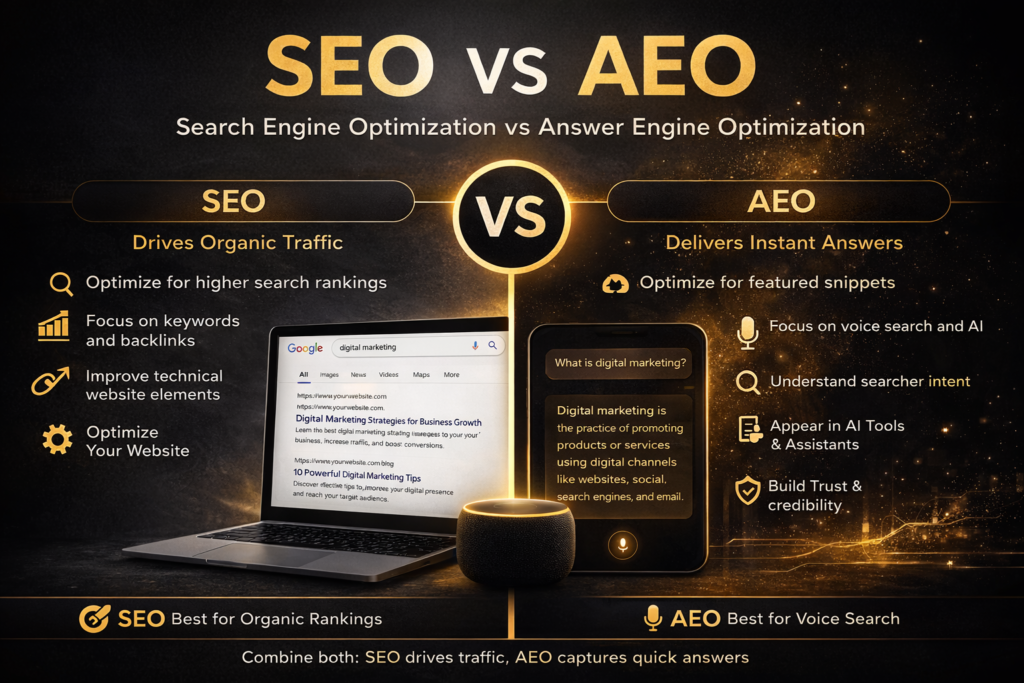
In today’s digital landscape, businesses are constantly competing for visibility online. Two powerful strategies—Search Engine Optimization (SEO) and Answer Engine Optimization (AEO)—play a major role in how content is discovered. While SEO has been the traditional approach for ranking on search engines, AEO is emerging as a modern strategy driven by AI, voice search, and smart assistants.
Understanding the difference between SEO and AEO is essential for anyone looking to grow online visibility and stay ahead of digital trends.
What is SEO?

Search Engine Optimization (SEO) is the strategic and ongoing process of enhancing a website’s structure, content, and overall performance to improve its visibility on search engines like Google, Bing, and Yahoo. In the context of SEO vs AEO, SEO focuses on improving rankings in search engine results pages (SERPs) through technical improvements, high-quality content creation, keyword research, and authority-building techniques. The primary goal of SEO is to achieve higher positions in search results, making it easier for users to discover your website when searching for relevant information, products, or services.
Unlike paid advertising, SEO generates organic (unpaid) traffic, which is more sustainable and cost-effective in the long term. By aligning a website with search engine algorithms and user intent, SEO not only increases visibility but also enhances user experience, builds credibility, and drives consistent business growth in the digital landscape.
How SEO Works
Search engines use automated systems called crawlers (bots) to scan websites and store information in an index. In the context of SEO vs AEO, when a user searches for something, the search engine shows the most relevant results based on ranking factors and user intent.
Principal Steps:
Finding fresh and updated pages through crawling
Content storage in a database is known as indexing.
Ranking: Presenting outcomes according to quality and importance
Main Steps:
- Crawling – Finding fresh and updated pages
- Indexing –Content storage in a database
3. Ranking –Results are shown according to quality and relevancy.
Types of SEO
1. On-Page SEO
Optimizing webpage elements is the main goal of on-page SEO.
Key factors:
- Keyword optimization
- Title tags and meta descriptions
- Header tags (H1, H2, H3)
- URL structure
- Internal linking
- Content quality
2. Off-Page SEO
In order to increase authority and trust, off-page SEO entails actions taken outside of your website.
Key factors:
- Backlinks (links from other websites)
- Social media engagement
- Brand mentions
- Influencer outreach
Technical SEO
Technical SEO ensures that your website is easy for search engines to crawl and index.
Key factors:
- Website speed
- Mobile-friendliness
- Secure connection (HTTPS)
- XML sitemap
- Fixing broken links
- Structured data
4. Local SEO
Businesses can appear in location-based searches with the use of local SEO.
Key factors:
- Google Business Profile optimization
- Local keywords (e.g., “digital marketing in Kochi”)
- Customer reviews
- Location-based content
Importance of SEO
- Increases Website Traffic
- SEO increases the number of people that visit your website by making it appear in the top search results.
- Builds Credibility and Trust
- Higher ranking websites are frequently regarded as more trustworthy.
- Cost-Effective Marketing
- SEO produces long-term results without ongoing expenditure, in contrast to sponsored advertisements.
- Better User Experience
SEO improves website structure, speed, and usability.
Key SEO Techniques
Keyword Research
- Use tools like as Google Keyword Planner to find the words that people search for.
Content Optimization
Create high-quality, informative, and engaging content.
Link Building
- To build authority, obtain backlinks from reliable websites.Mobile Optimization
Mobile Optimization
Ensure your website works well on smartphones.
Page Speed Optimization
Websites that load quickly rank higher and enhance user experience.
SEO Ranking Factors

Some of the most important ranking factors include:
- Quality and relevance of content
- Backlinks and domain authority
- User experience (UX)
- Mobile responsiveness
- Page speed
- Keyword usage
- Secure website (HTTPS)
Common SEO Mistakes to Avoid
- Keyword stuffing
- Duplicate content
- Ignoring mobile optimization
- Slow website speed
- Poor-quality backlinks
- Not updating content regularly
Future of SEO

SEO is constantly evolving with technology. In the discussion of SEO vs AEO, trends like voice search, AI, and Answer Engine Optimization (AEO) are shaping the future of search. Search engines are becoming smarter and focusing more on user intent rather than just keywords.
What is AEO?

(AEO) is the advanced process of optimizing digital content so that it can be directly selected and presented as a clear, accurate answer by search engines, AI-powered platforms, and voice assistants such as Google Assistant, Siri, and Amazon Alexa. In the context of SEO vs AEO, AEO goes beyond traditional SEO by focusing on delivering precise, concise, and contextually relevant answers that satisfy user intent instantly—often without requiring users to visit a website.
This involves structuring content in a way that search engines and AI systems can easily interpret, such as using question-and-answer formats, featured snippets, structured data (schema markup), and conversational language. As technology continues to evolve with the rapid growth of AI tools, chatbots, and voice search, users increasingly expect immediate responses rather than browsing multiple pages for information. Therefore, AEO plays a crucial role in modern digital marketing by helping businesses position their content as the most reliable and authoritative source of answers, improving visibility across emerging platforms, enhancing user experience, and ensuring they remain competitive in an increasingly AI-driven search landscape.
How AEO Works
In the context of SEO vs AEO, AEO works by helping search engines and AI systems understand your content and choose it as the best answer.Main Process:
- User asks a question (typed or voice)
- Search engine/AI analyzes intent
- System selects the most relevant, clear answer
- Answer is displayed directly (featured snippet, voice reply, chatbot response)
Key Features of AEO

1. Focus on User Intent
In the context of SEO vs AEO, AEO is based on understanding what the user really wants to know, not just keywords.
2. Direct Answers
In the context of SEO vs AEO, content should provide clear, short, and accurate answers to specific questions.
3. Structured Content
Using formats like:
- Bullet points
- Numbered lists
- FAQs
- Tables
4. Voice Search Optimization
AEO supports voice queries like:
- “What is SEO?”
- “Best digital marketing tips?”
Content should be conversational and natural.
5. Featured Snippets Optimization
AEO helps your content appear in:
- Google answer box
- “People also ask” section
6. Use of Structured Data (Schema Markup)
In the context of SEO vs AEO, schema helps search engines understand your content better and improves the chances of being selected as an answer.
Types of AEO Content

- FAQ Pages
- How-to Guides
- Step-by-step tutorials
- Definition-based content
- Short explanatory paragraphs
Importance of AEO

1. Improves Visibility in AI Search
Your content can appear in voice assistants and AI tools.
2. Increases Authority
Being selected as a direct answer builds trust and credibility.
3. Boosts Click-Through Rate (CTR)
Featured answers attract more attention and clicks.
4. Future-Proof Strategy
AEO aligns with the future of search (AI and voice-based search).
Key AEO Techniques
1. Answer Questions Clearly
Start content with a direct answer in 1–2 sentences.
2. Use Question-Based Headings
Example:
- What is AEO?
- How does AEO work?
3. Optimize for Featured Snippets
- Keep answers short (40–60 words)
- Use bullet points
- Add tables
4. Use Simple Language
Avoid complex words—make content easy to understand.
5. Add Structured Data
Use schema markup like:
- FAQ schema
- How-to schema
Common AEO Mistakes to Avoid

- Writing long, unclear answers
- Ignoring user intent
- Not using structured data
- No FAQ sections
- Over-complicated language
Future of AEO

In the evolving landscape of SEO vs AEO, the future of Answer Engine Optimization (AEO) is rapidly expanding as AI technologies and voice search continue to reshape how users access information online. In the discussion of SEO vs AEO, AEO is becoming increasingly important as users expect instant, accurate, and conversational answers rather than browsing multiple web pages.
With the growing use of smart assistants, chatbots, and AI-powered search platforms, AEO is becoming essential for businesses that want to stay competitive, as it focuses on delivering precise responses that match user intent in real time. As search engines become more intelligent, prioritizing context and meaning over traditional keyword matching, AEO will play a critical role in content strategy. Businesses that adopt structured data, optimize for featured snippets, and create question-based, user-focused content will have a significant advantage.
Ultimately, in the era of SEO vs AEO, the future of AEO lies in its ability to integrate seamlessly with SEO, ensuring both visibility and instant answer delivery in an increasingly AI-driven digital ecosystem.
AEO is growing rapidly due to:
- AI tools (like chatbots)
- Voice assistants (Alexa, Google Assistant)
- Smart search engines
In the future, users will rely more on instant answers rather than browsing multiple websites.
SEO vs AEO: Which is Better?
The truth is—neither is better alone.
- SEO is still essential for driving website traffic.
- AEO is crucial for future search trends and AI platforms.
The best strategy is to combine both:
- Use SEO to rank your content
- Use AEO to make your content answer-focused
How to Optimize for Both SEO and AEO
1. Focus on User Intent
Understand what users are really asking and create content that solves their problems.
2. Use Question-Based Content
Include headings like:
- What is SEO?
- How does AEO work?
3. Optimize for Featured Snippets
- Use bullet points
- Write clear and concise answers
- Add FAQs
4. Implement Structured Data
Help search engines understand your content better.
5. Improve Content Readability
- Short paragraphs
- Simple language
- Clear formatting
Conclusion
In conclusion, in the debate of SEO vs AEO, both Search Engine Optimization (SEO) and Answer Engine Optimization (AEO) play vital roles in shaping the future of digital visibility. SEO remains a strong foundation for driving organic traffic, improving website rankings, and building long-term online presence through strategies like keyword optimization, content creation, and link building on platforms such as Google, Bing, and Yahoo.
On the other hand, AEO represents the next evolution of search by focusing on delivering direct, instant, and accurate answers through AI-driven systems and voice assistants like Google Assistant, Siri, and Amazon Alexa. As user behavior shifts toward quick answers and conversational queries, relying solely on traditional SEO is no longer enough. Businesses and content creators must adopt a combined strategy that integrates both SEO and AEO—using SEO to ensure visibility and rankings, while leveraging AEO to capture featured snippets, voice search results, and AI-generated responses. By aligning content with user intent, maintaining clarity, and using structured formats, organizations can stay competitive, enhance user experience, and succeed in an increasingly AI-powered search landscape.
Athoer:Faseeh