
Introduction
In today’s competitive digital landscape, attracting customers is not enough—you need a structured approach to guide them from awareness to purchase. This is where the marketing funnel plays a crucial role. It helps businesses understand the customer journey and create strategies that convert prospects into loyal customers.
The marketing funnel is a step-by-step process that represents how potential customers move through different stages before making a buying decision. By understanding each stage, businesses can deliver the right message at the right time.
What is a Marketing Funnel?
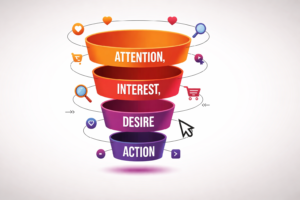
The funnel typically consists of three main stages:
Top of the Funnel (TOFU) – Awareness
Middle of the Funnel (MOFU) – Consideration
Bottom of the Funnel (BOFU) – Decision
To get prospects closer to conversion, a distinct marketing strategy is needed for each stage.
Why is the Marketing Funnel Important?
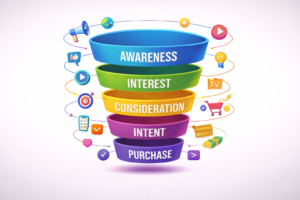
It helps you understand what your audience needs at each stage of their journey.
2. Increases Conversion Rates
By targeting users with relevant content, you can guide them smoothly toward making a purchase.
3. Optimizes Marketing Efforts
Instead of random marketing, you focus on strategies that align with customer intent.
4. Builds Strong Relationships
The funnel ensures continuous engagement, which builds trust and long-term loyalty.
Top of the Funnel (TOFU) – Awareness Stage
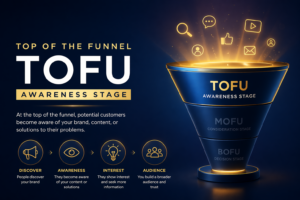
The Top of the Funnel (TOFU), also known as the awareness stage, is the first step in the digital marketing funnel where potential customers are introduced to a brand, product, or service. At this stage, people may not yet recognize their problem or may just be beginning to explore it, so the goal of the digital marketing funnel is to attract attention and provide valuable, educational content.
Businesses focus on creating blog posts, social media content, videos, and infographics that inform and engage rather than sell. The main objective of the digital marketing funnel at this stage is to build visibility, generate interest, and establish trust, encouraging users to learn more and move further down the funnel.
Goals:
- Attract attention
- Educate the audience
- Increase visibility
Content Types:
- Blog posts
- Social media content
- Infographics
- Educational videos
Example:
A user searching “What is digital marketing?” is in the awareness stage.
Middle of the Funnel (MOFU) – Consideration Stage
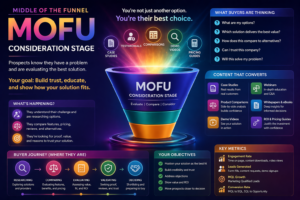
The Middle of the Funnel (MOFU), also known as the consideration stage, is a crucial phase in the digital marketing funnel where potential customers have identified their problem and are actively searching for solutions. At this point, they are evaluating different options and comparing alternatives, making it essential for the digital marketing funnel to focus on building trust and providing deeper value.
Instead of general information, the focus shifts to more detailed and solution-oriented content such as case studies, product comparisons, webinars, and email campaigns. The goal of the digital marketing funnel at this stage is to educate prospects, address their concerns, and position your brand as the best possible choice, guiding them closer to making a decision.
Goals:
- Build trust
- Provide value
- Help evaluate options
Content Types:
- Case studies
- Webinars
- Email marketing
- Comparison guides
Example:
A user comparing “SEO vs Paid Ads” is in the consideration stage.
Bottom of the Funnel (BOFU) – Decision Stage
- Convert leads into customers
- Remove objections
- Provide reassurance
Content Types:
- Product demos
- Testimonials
- Free trials
- Discounts and offers
Example:
A user searching “Best digital marketing agency near me” is ready to buy.
How to Create an Effective Marketing Funnel
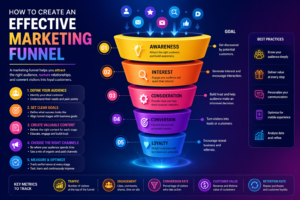
- Understand Your Target Audience
- Create Valuable Content
- Use Multiple Channels
- Capture Leads
- Nurture Leads
- Optimize for Conversions
Content Strategy for Each Funnel Stage
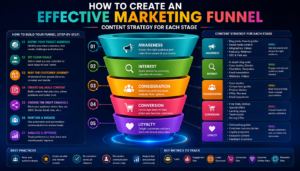 A A strong content strategy for each stage of the marketing funnel ensures that your audience receives the right information at the right time. In the awareness stage of the marketing funnel, the focus should be on educational and engaging content such as blog posts, social media updates, and videos that attract attention and introduce your brand.
In the consideration stage, content within the marketing funnel should provide deeper insights and solutions through case studies, comparison guides, webinars, and email campaigns to build trust and credibility. Finally, in the decision stage, the marketing funnel content should be highly persuasive, including testimonials, product demos, reviews, and special offers that encourage users to take action. By aligning content with each stage of the marketing funnel, businesses can effectively guide prospects toward conversion.
TOFU Content Strategy
Focus on awareness and education:
- “What is…” articles
- Beginner guides
- Industry trends
MOFU Content Strategy
Focus on evaluation:
- Case studies
- Product comparisons
- Email sequences
BOFU Content Strategy
Focus on conversion:
- Testimonials
- Reviews
- Limited-time offers
Common Mistakes to Avoid in a Marketing Funnel
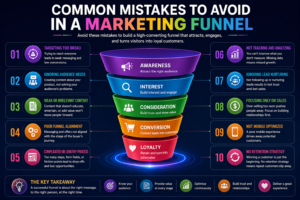
Common mistakes in a marketing funnel can significantly reduce its effectiveness and lead to lost opportunities. One major mistake is not understanding the target audience within the marketing funnel, which results in irrelevant messaging and poor engagement. Another common issue is focusing too much on selling too early, especially in the awareness stage of the marketing funnel, where education and trust-building should come first.
Businesses also often neglect lead nurturing in the marketing funnel, failing to stay connected with prospects through consistent communication. In addition, ignoring data and analytics prevents identifying weak points in the marketing funnel, making it difficult to improve performance. Lastly, having inconsistent messaging across different stages of the marketing funnel can confuse potential customers and weaken brand trust, ultimately lowering conversion rates.
- Lack of Clear Goals
- gnoring Audience Needs
- Overcomplicating the Funnel
- Inconsistent Messaging
- Not Tracking Performance
Tools to Build and Optimize a Marketing Funnel
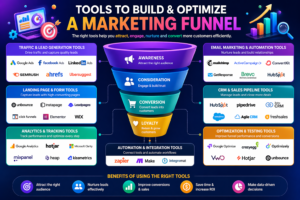
In order to effectively manage client journeys and increase conversions, marketing funnel building and optimization tools are essential. Businesses use analytics tools to track user behavior and measure performance within the marketing funnel, helping identify which stages need improvement. Email marketing platforms are essential for nurturing leads through the marketing funnel with personalized communication, while Customer Relationship Management (CRM) systems help organize and manage customer data.
Additionally, landing page builders and automation tools streamline lead capture and follow-up processes in the marketing funnel, saving time and increasing effectiveness. By using the right combination of tools, businesses can create a more structured, data-driven marketing funnel that enhances customer experience and drives better results.
To create an effective funnel, businesses use various tools such as:
- Analytics tools (to track performance)
- Email marketing platforms
- CRM systems
- Landing page builders
These tools help streamline the process and improve efficiency.
Benefits of a Well-Designed Marketing Funnel
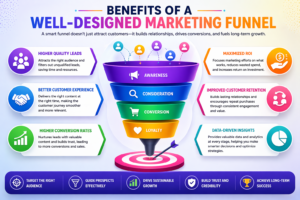
A well-designed marketing funnel offers several key benefits that help businesses grow more effectively and efficiently. It allows companies to attract the right audience through the marketing funnel and guide them through a structured journey, resulting in higher-quality leads and improved conversion rates.
By delivering relevant content at each stage of the marketing funnel, businesses can build trust, enhance customer experience, and strengthen relationships over time. Additionally, a clear marketing funnel helps optimize marketing efforts by reducing wasted resources and focusing on strategies that deliver results. It also provides valuable insights through data and analytics, enabling continuous improvement and better return on investment (ROI) within the marketing funnel.
- Better Lead Quality
- Higher ROI
- Improved Customer Experience
- Increased Customer Retention
Conclusion
The marketing funnel is a powerful and essential framework that helps businesses guide potential customers through every stage of their journey, starting from initial awareness and moving toward final conversion. By clearly understanding how customers think, behave, and make decisions at each stage, businesses can create and deliver the right content that educates, engages, and builds trust. This structured approach not only improves the overall customer experience but also increases the chances of converting prospects into paying customers, ultimately leading to higher sales and better marketing results.
A successful marketing funnel goes beyond simply selling products or services—it focuses on building meaningful and lasting relationships with the audience. By consistently providing value, addressing customer needs, and maintaining engagement even after the purchase, businesses can foster loyalty and long-term connections. When implemented effectively, a marketing funnel becomes a sustainable growth strategy that enhances brand reputation, improves customer retention, and ensures continuous business success in a competitive market.Athoer:Faseeh